


Nebraska experiences shape Shultz-Ramer’s path in agriculture
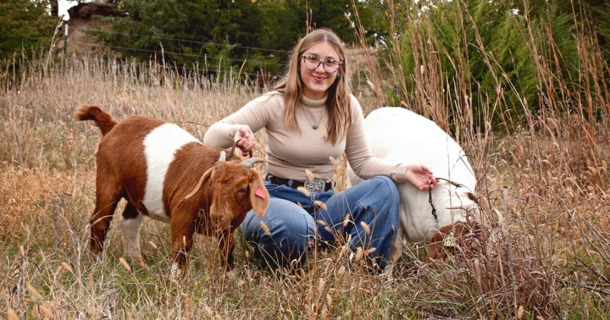
Lincoln, Neb., October 19, 2026 —Alyvia Shultz-Ramer didn’t grow up on a farm or ranch. But agriculture has been shaping her life since she first found a place in it through Nebraska 4-H.
Today, the Kearney native is a junior in the College of Agricultural Sciences and Natural Resources at the University of Nebraska–Lincoln, where she is studying agricultural leadership, education and communications and preparing for a career in agriculture.
Her path began with 4-H and goats, grew through FFA at Kearney High School and eventually brought Shultz-Ramer to Nebraska’s East Campus. This summer, that path extended beyond campus through an internship with the U.S. Meat Export Federation.
Each experience has built on the one before it, helping Shultz-Ramer find her place in agriculture and develop the skills to contribute to its future.
Finding agriculture through 4-H
Shultz-Ramer grew up in Kearney without a family background in agriculture. Her parents didn’t farm or ranch, and the family lived in town. But through 4-H she began showing goats, and by eighth grade, she wanted to raise them herself.
Shultz-Ramer and her dad traveled to Oklahoma to purchase a doe, and a few months later, she and her mom traveled to Missouri for a buck. Because the family lived in town, Shultz-Ramer found a local woman willing to let her keep the animals on her property.
What started with a couple of goats eventually grew into a herd of about a dozen and became Shultz-Ramer’s supervised agricultural experience project through FFA. As her herd grew, so too did her affinity for livestock production.
Since neither of her parents came from an agricultural background, raising livestock often meant learning by doing.
“I learned a ton,” Shultz-Ramer said. “Literally everything about taking care of livestock and how not to freak out when things don’t go perfectly.”
There were difficult births, bottle babies, bitter Nebraska winters and livestock losses. Those experiences taught Shultz-Ramer about the responsibility and uncertainty that come with raising animals — and strengthened her interest in agriculture.
“There are so many things that are out of our control,” she said. “That’s why it’s so important for young people to continue to go into production agriculture.”
Building on that foundation through FFA
At Kearney High School, FFA gave Shultz-Ramer another place to explore agriculture. She immersed herself in activities and competitions and even stepped away from soccer after more than 13 years so she could devote more time to FFA.
Her agricultural education teacher and FFA adviser, Sheridan Swotek, a College of Agricultural Sciences and Natural Resources alumna, became an important mentor.
“She’s been super influential,” Shultz-Ramer said. “A lot of the things that I’m involved in and the people that I know are because of her introducing me to people.”
Through 4-H and FFA, Shultz-Ramer knew agriculture was where she wanted to be. She just wasn’t sure what career within the industry was right for her.
For a time, she thought she might become a veterinarian. A job at a veterinary clinic helped her realize it wasn’t the right fit. Inspired in part by the agricultural educators who had influenced her, Shultz-Ramer eventually chose agricultural education as her college major.
Deciding where to study took some exploration, too.
Finding her place at Nebraska
Nebraska wasn’t initially where Shultz-Ramer expected to attend college.
She considered Louisiana State University and the Nebraska College of Technical Agriculture and initially planned to attend the latter. Lincoln seemed big, and Shultz-Ramer wasn’t sure the University of Nebraska–Lincoln would offer the close-knit community she wanted.
A visit to the College of Agricultural Sciences and Natural Resources changed her mind. What stood out was not simply the programs available to her, but the people who took the time to learn who she was and what she wanted from her education.
“I could just tell that they wanted me there,” Shultz-Ramer said. “Where else am I going to go where the dean of CASNR or professors are going to know me by name? I just think that’s super cool about CASNR. It’s a family. It really is. I think any one of my professors would go to bat for their students.”
On East Campus, Shultz-Ramer found the close-knit agricultural community she valued in 4-H and FFA while gaining access to the opportunities available at a major land-grant university.
“You’re getting the small-town feel but all of the big D-I school opportunities,” she said.
Discovering agricultural communications
Shultz-Ramer arrived at Nebraska studying agricultural education, but her college gave her room to continue exploring where her interests and strengths could lead.
A conversation with Laura Young, a professor in the College of Agricultural Sciences and Natural Resources, led Shultz-Ramer to take a closer look at agricultural communications. She began to see a field that could combine her interest in agriculture with something else she had always enjoyed — connecting with people and hearing their stories.
“I love talking to people. I love hearing people’s stories,” Shultz-Ramer said. “I love getting to learn about people all the time, and communications really allows me to do that.”
Through her coursework, Shultz-Ramer is developing skills in writing, interviewing, photography and communicating with different audiences. Rather than tying her to one segment of agriculture, she sees those skills as tools she can carry throughout her career.
“I really feel like I’m learning valuable skills,” she said. “Those are all valuable skills that I can use at any job.”
From Nebraska to global agriculture
This summer, Shultz-Ramer took another step in her professional development through an internship at the Denver headquarters of the U.S. Meat Export Federation.
The federation works across the U.S. red meat industry to develop international markets for U.S. beef, pork and lamb. Its work gave Shultz-Ramer an inside look at how producers and other sectors of agriculture connect to customers and markets around the world.
“I got to meet so many people and really see how many different factors go into agricultural trade,” Shultz-Ramer said. “There’s so much happening behind the scenes that I had never thought about before. It really opened my eyes to how connected agriculture is and how many different career opportunities there are within the industry.”
Nebraska 4-H gave Shultz-Ramer an entry point into agriculture. FFA helped her deepen that involvement, develop skills and build relationships across the industry. At the College of Agricultural Sciences and Natural Resources, she found a community that encouraged her to explore and an academic program that is helping turn those interests into a career. Now, opportunities such as her internship are allowing her to put those skills to work and see agriculture from a global perspective.
Shultz-Ramer's journey also reflects Nebraska’s role in preparing the next generation of people who will work in and lead agriculture. Through education, hands-on experiences, mentorship and connections with industry, students can build on their interests and develop the skills needed to contribute to agriculture in Nebraska and beyond.
For Shultz-Ramer, that preparation hasn’t meant having every step mapped out. Instead, Nebraska has given her opportunities to explore, change direction and discover where she fits.
The student who began with a few goats in Kearney is now seeing how agriculture connects Nebraska producers to consumers and markets around the world — and beginning to see the role she can play in its future.